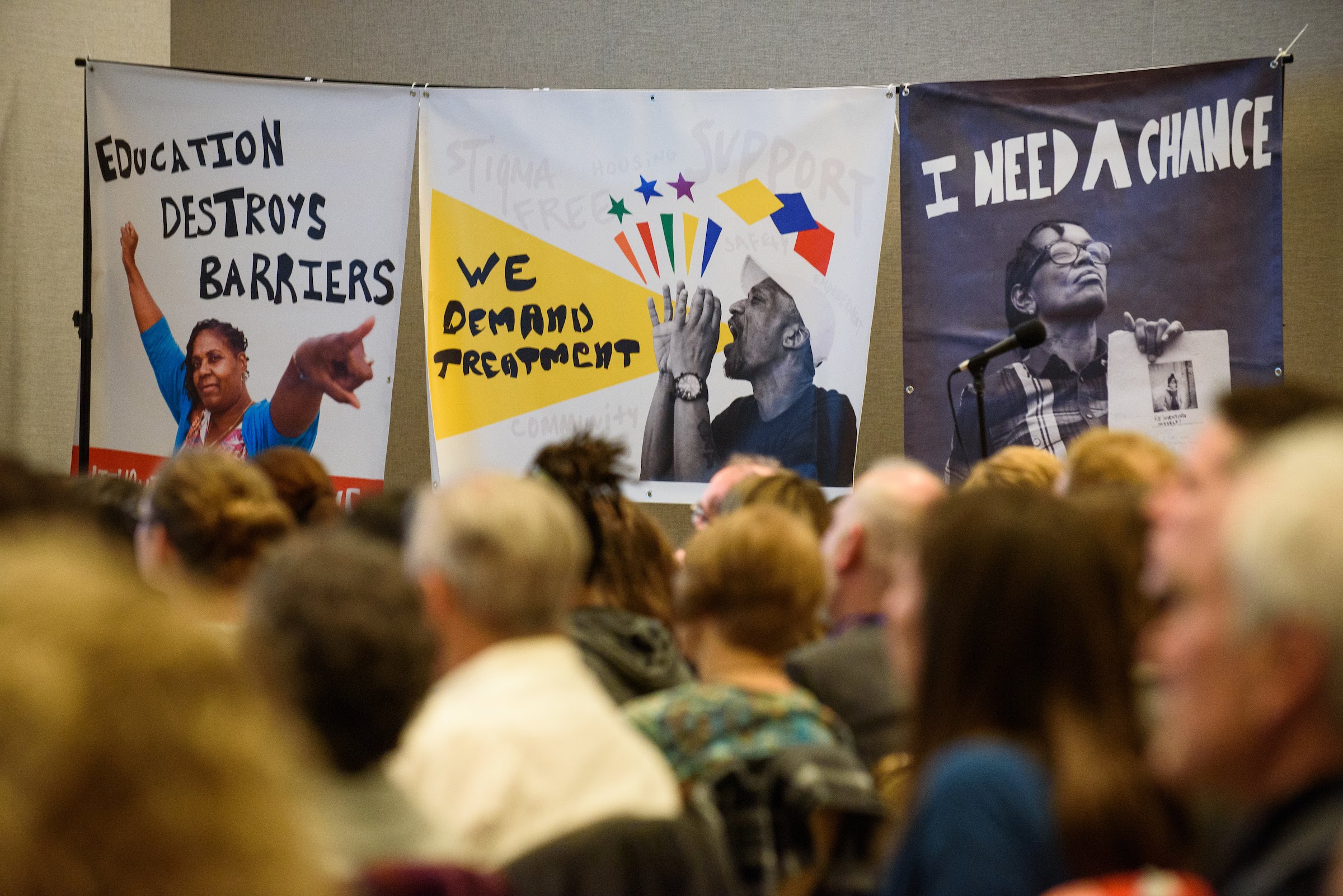
Artwork stating 'Education Destroys Barriers', 'We Demand Treatment', and 'I Need A Chance'

Search Results

You searched for: -

There are 17340 results  for your search.  View and Refine Your Search Terms

  • Out of Prison, Into a Vicious Circle of Debt

    Many offenders get out of jail owing hundreds or thousands of dollars in court and parole fees but face barriers to financing and job acquisition, sticking them in a punitive, vicious cycle of debt and arrest. A program called the Clapham Set, perhaps paired with conditional cash transfers - may be a solution, as it erases fees for felons who complete rehab and job training upon release.

    Read More

  • Paying for Their Crimes, Again

    Felons get out of jail owing hundreds or thousands of dollars in court and parole fees, acting as an often insurmountable barrier preventing them from reintegrating into society and staying out of jail. What's worse, these fees often end up costing the state more than they produce. Two columns on a program called the Clapham Set, which erases or reduces debts for felons who take classes and job training.

    Read More

  • Class Struggle: India's Experiment in Schooling Tests Rich and Poor

    The country of India has long suffered from extreme income inequalities, with many poor children growing up with lackluster education. The Right to Education Act, passed in 2009, requires elite private schools to admit 25% low-income or disabled children. The law's success is measured at the Shri Ram School in New Delhi, and some wealthy families are unsatisfied with its inclusiveness.

    Read More

  • A Way to Pay for College, With Dividends

    Low-income students are always looking for ways to finance their education. A new system using “human capital contracts” to pay for higher education isn’t as scary as it sounds.

    Read More

  • Surviving and thriving: What works to make teens stronger, more resilient

    In East Oakland, teens experience random violence, a lack of healthy food, and other sources of chronic stress. The consequences can be grave. At one school, the dropout rate is one in two. Learning to be resilient helps teens survive and even thrive. Multiple efforts are helping East Oakland teens to build this skill, including by connecting them with role models and mentors.

    Read More

  • Instead of Student Loans, Investing in Futures

    For millions of students who could succeed in college, the limiting factor is money. Is it possible to finance higher education the way we finance start-up companies? A company called Lumni uses “human capital contracts” to offer loans for students contingent upon 14 percent of the student's salary for 118 months after graduation. There are risks to this approach and not a lot of years or data available to be sure of its efficacy, but results are promising already—with a default rate under 3 percent.

    Read More

  • The Man Who Had HIV and Now Does Not

    The medical community had essentially given up hope for a cure for aids and thus little to no money was devoted to the research. A man with aids was cured in Berlin, by an optimistic doctor and a stem-cell transplant, and the medical community has begun researching again to see if the solution is replicable on a larger scale.

    Read More

  • The Path From Charity to Profit

    In Jakarta’s slums, families can’t buy their children nutritious food. So Mercy Corps started a for-profit chain of food carts selling healthy kids’ meals. A second column highlights the challenges NGOs face when they try to start for-profit businesses.

    Read More

  • In ‘Food Deserts,' Oases of Nutrition

    Asian cities are over-crowded and many residences are kitchenless, causing families with children to consume unhealthy food from the street vendors. Mercy Corps, a non-profit organization that advocates nutrition, has initiated some for-profit businesses in Jakarta that provide healthy food to underserved neighborhoods. The food carts are marketed at serving poor children a healthy meal.

    Read More

  • Artificial Leaves Might Help Power the World

    With no system in place for replicating photosynthesis on a commercial level, scientists throughout the U.S. began efforts to create one. What they have come up, in the form of artificial leaves, may be the answer to turning sunlight into useable energy on a scaleable level.

    Read More